Phone boards compress a computer into a few square inches, and board-level repair — the work that separates a repair shop from a parts-swap shop — happens entirely under magnification. The microscope's daily jobs: finding the shorted capacitor, inspecting FPC connectors for bent pins and corrosion, reading board damage after liquid ingress, and guiding hot-air rework of shields and ICs.
The working brief matches PCB repair with two phone-specific twists. First, the whole board view matters: schematics and boardview software orient you, but the microscope's low-power view is where you correlate the map with the territory, which argues for a wide low end (camera stations excel here). Second, documentation is a customer-relations tool: a photo of the corrosion you found ends arguments about repair scope and price.
Working distance of three inches or more keeps hot air and tweezers comfortable; autofocus camera heads earn fans in phone repair because boards move in and out of fixtures constantly and refocusing by hand costs seconds hundreds of times a day. A thermal camera is a separate instrument and a fine partner, but it does not replace the optical view for connector and trace work.
Stereo microscopes remain common in phone benches for the depth judgment on connectors and solder balls; trinocular versions add the camera for documentation. Choose the station around your dominant job: diagnosis-and-rework volume favors the HDMI camera; precision connector work favors stereo depth.
Recommended specifications
Whole-board low-power view for schematic correlation
Working distance: 3 in+ for hot air and tweezers
Autofocus helpful for high-throughput benches
Capture for customer documentation of faults found
Magnification: 10x–45x optical range covers phone boards
Recommended products
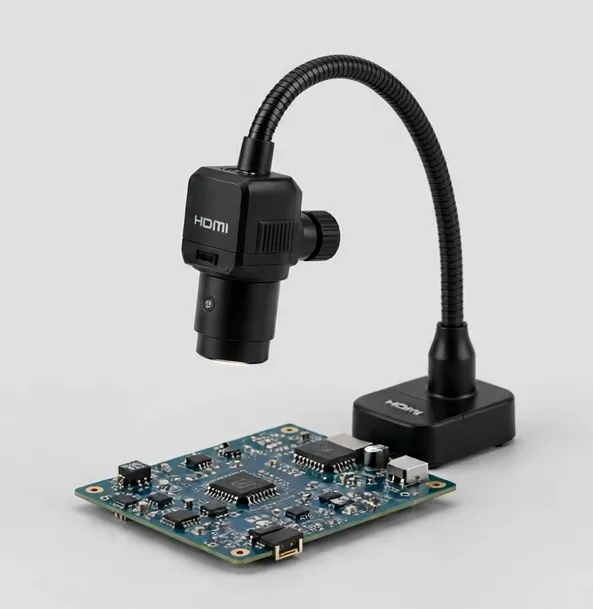
4K HDMI camera microscope on a flex arm — autofocus keeps joints sharp while you work
A 4K HDMI inspection camera on a flexible arm with autofocus and on-screen measurement. Long working distance leaves room for an iron, tweezers and hot air.
None built in — HDMI output to your monitorApprox. 10x–280x optical zoomWorking distance to 8 in
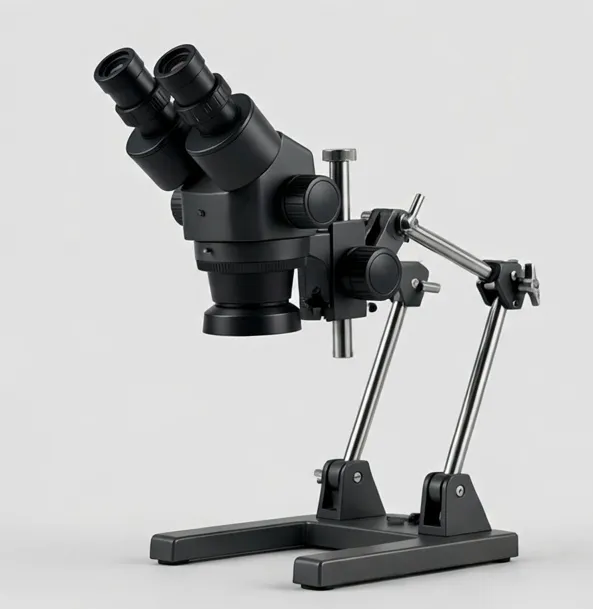
A boom-arm camera microscope with two swappable lenses — a wide lens for whole-board orientation and a detail lens for joints — feeding HDMI and USB at once.
None built in — HDMI output to your monitorApprox. 8x–260x optical across two lensesWorking distance to 9 in
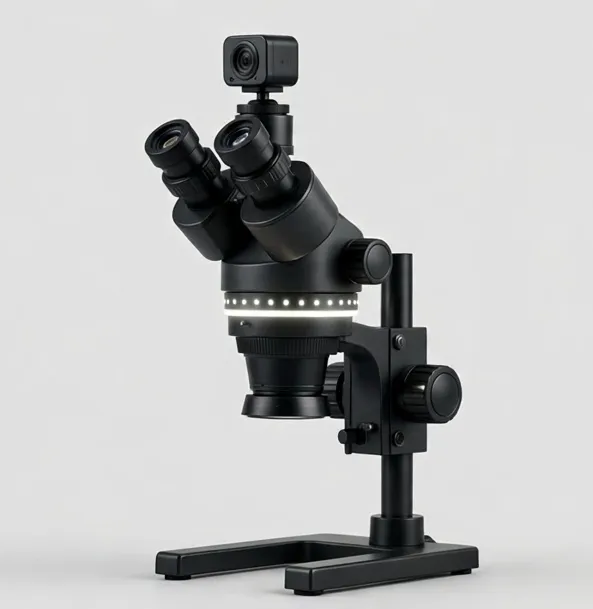
A trinocular stereo microscope (3.5x–90x with included Barlow lenses) with an HDMI camera and LED ring light — demonstrate, record and inspect in one station.
7x–45x optical zoom; 3.5x–90x with included 0.5x and 2x Barlow lensesWorking distance to 4 in
Commonly an HDMI camera station on an arm — fast, shared, and easy to document from. Stereo and trinocular stations are chosen where connector and rework precision dominates.
Can I find a short circuit with a microscope?
You find its evidence: burnt or discolored components, corrosion, damaged traces. Electrical confirmation still comes from your meter and power supply; the microscope directs them.
Do I need autofocus for phone repair?
Not need — but on a busy bench, autofocus saves repeated refocusing as boards swap in fixtures. Technicians who have it rarely go back.
What magnification suits FPC connector inspection?
Roughly 15x–35x: enough to see individual pins and bent contacts clearly with room to work.